


Walk into any well-run consignment store in 2026 and you will notice something that surprises most people. The checkout is fast. The inventory is tagged, tracked, and searchable. Consignor payouts happen automatically. And the owner, instead of drowning in spreadsheets, is reviewing margin reports on a tablet from the back office.
This is not the cluttered thrift shop of ten years ago. Modern consignment software has turned secondhand retail into a lean, tech-enabled operation. Paired with the right POS system and barcode tools, these stores are pulling off something that would make many high street retailers uncomfortable: higher margins, lower overhead, and a more loyal customer base.
Here is how they are doing it, and which tools are making it possible.
The Consignment Advantage Nobody Talks About
Consignment stores operate on a fundamentally different model than traditional retail. They do not buy inventory upfront. They take goods on consignment from individuals, sell those goods, and split the revenue with the consignor. That means no purchasing risk, no warehousing costs for unsold stock, and no markdowns eating into profit.
But that model only works smoothly when the back end is organized. Without the right software, managing hundreds or thousands of consignors, each with their own items, pricing agreements, payout schedules, and account balances, becomes a full-time administrative headache. This is exactly where consignment-specific software earns its keep.
The best platforms handle consignor account management, automated payouts, inventory aging, markdown schedules, barcode label printing, and POS transactions in a single system. That tight integration is what allows a two-person consignment shop to process transactions and manage inventory at a pace that rivals stores with ten times the staff.
What to Look for in Consignment Software
Not all consignment platforms are created equal. Before picking one, buyers should focus on a few things that separate capable tools from those that merely check a box.
Consignor management depth. The software should let you create individual consignor accounts with custom commission splits, track balances, automate payout calculations, and give consignors a way to check in on their own items. Platforms that offer consignor self-service portals save enormous amounts of time for store staff.
Integrated POS with barcode scanning. A consignment store's POS needs to do more than ring up sales. It needs to tie each transaction back to the consignor who owns the item, apply the correct split, and update inventory in real time. Barcode scanning is essential here. Every item that comes through the door should get a printed label with a unique barcode so that checkout is fast, accurate, and traceable.
Flexible pricing and markdown rules. Consignment inventory ages differently than new retail stock. Good software lets you set automatic markdown schedules, so items that have been sitting too long get discounted on a timeline you control, without manual intervention.
Multi-channel selling. Many consignment shops now sell online alongside their physical storefront. The software should support integration with platforms like Shopify, eBay, or dedicated resale marketplaces, and keep inventory synchronized across channels.
Reporting that actually helps. You need to see sell-through rates, consignor performance, revenue trends, and payout liabilities at a glance. Detailed reporting turns guesswork into strategy.
The Tools That Are Getting It Done
The consignment software category on Serchen lists a solid range of platforms built specifically for this niche. Here are the ones worth a closer look, based on features, pricing, and real-world reputation.
SimpleConsign
SimpleConsign is the most widely reviewed consignment platform on the market right now, and for good reason. It is a fully web-based system that combines POS, consignor management, inventory control, and reporting into one package. The system runs on any device with a browser, which means no proprietary hardware requirements.
What makes SimpleConsign stand out is its depth. It supports unlimited consignors and inventory items on every plan, offers ACH consignor payouts, includes a reward points system for customers, and integrates directly with Shopify for stores that want an online channel. Barcode scanning is built into checkout and inventory management, and the label printing tools support multiple formats.
Pricing starts at $99 per month for the Store Launch Program, which includes all Professional plan features and is available until you hit $75,000 in revenue or one year, whichever comes first. After that, the Basic plan runs $159 per month, Standard is $259, and Professional is $359. Every tier includes unlimited terminals, which is a meaningful advantage for stores that want multiple checkout stations without paying per register.
User reviews consistently praise the customer support team and the Shopify integration. The most common criticism is that the interface, while functional, can feel dense when you first start using it. But the learning curve flattens quickly, and the help center documentation is thorough.
Ricochet
Ricochet was built by former consignment store operators, and that firsthand experience shows in the product. It is the only consignment software that runs fully on an iPad, which makes it a strong fit for stores that want a clean, modern checkout experience without a bulky desktop terminal.
Ricochet covers all the essentials: POS, inventory management with barcode label printing from Mac, PC, or iPad, consignor accounts, payout management, and reporting. Its standout feature is Ricochet Go, a companion app that lets consignors log into their own account to add inventory, check balances, and receive notifications when items sell. That self-service capability alone can save store owners hours of consignor communication each week.
The platform integrates with QuickBooks for accounting sync and Avalara for sales tax automation. For stores that want to sell online, Ricochet offers a web store add-on at $79 per month on top of the $199 per month base price.
Reviews rate Ricochet highly for ease of use and customer support, with an average score of 4.7 out of 5 across major review platforms. The main drawback is cost. At $199 per month (or $278 with the web store), it is one of the pricier options for small shops, though the single-tier pricing means you get every feature without worrying about plan upgrades.
ConsignCloud
ConsignCloud positions itself as a modern, no-fuss option for consignment and resale stores. It is cloud-based, supports integrated card payments through Stripe, and connects with both Shopify and Square for stores that already use those ecosystems.
The platform handles consignor accounts, inventory management, automatic consignor communications, and POS transactions. Barcode scanning works with standard hardware, and you can use existing receipt printers and cash drawers rather than buying proprietary equipment. ACH payouts are available through Checkbook integration at $1.79 per payout.
Pricing starts at $139 per month for the Basic plan, which includes unlimited accounts, items, and sales, plus up to three users. The Professional plan at $149 per month adds features like advanced reporting and more add-ons, while the Enterprise plan at $179 per month unlocks everything.
ConsignCloud gets solid marks for its Shopify integration and responsive customer service. Some users have noted that the reporting and data filtering tools could be more intuitive, and international tax handling has been a pain point for stores outside the US.
Bravo Store Systems
Bravo Store Systems takes a different approach. Originally built for pawn shops, Bravo has expanded into a full-featured platform for consignment, buy-sell-trade, and secondhand retail. It is arguably the most feature-rich option on this list, though it is designed for stores that need more than basic consignment management.
Bravo's consignment module tracks consigned items alongside store-owned inventory, supports automated payouts, and includes an AI-powered pricing tool called the Hard Goods Estimator that recommends prices based on item condition and market data. The platform also auto-lists items on eBay, Buya.com, and a branded marketplace site that Bravo builds for your store, giving you multi-channel selling without the manual listing work.
The system includes compliance features that matter for stores dealing in firearms, electronics, or other regulated goods, including police reporting integration and hold period tracking. Over 4,000 stores run on Bravo, and it was named a Fall 2025 Top Performer by SourceForge.
Bravo does not publish standard pricing on its website; you will need to request a demo. This reflects the platform's positioning toward larger or more complex operations. For a single-location consignment boutique, it may be more system than you need. But for a multi-location resale operation or a store that mixes consignment with buy-outright and trade-in models, Bravo is hard to beat.
CrossPostIt
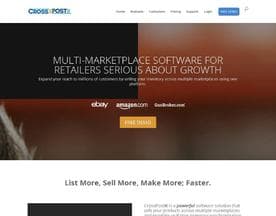
CrossPostIt started as consignment software and has grown into a multi-channel listing and inventory management tool for online sellers. If your consignment store does significant volume through eBay, Amazon, or other online marketplaces, CrossPostIt is worth evaluating.
The platform supports bulk inventory imports, barcode generation, real-time quantity synchronization across marketplaces, consignor management with custom commission plans, and automated payout tracking. It is less of a traditional POS system and more of an inventory and marketplace management hub, which makes it a strong complement to a storefront POS rather than a replacement for one.
CrossPostIt is now part of Bravo Store Systems (formerly Data Age Business Systems), so stores already using Bravo can extend their multi-channel reach through it.
Why Barcode Scanning Matters More Than You Think
One detail that separates efficient consignment shops from struggling ones is barcode adoption. In a traditional retail store, products arrive with manufacturer barcodes already printed. In consignment, every single item is unique. A vintage jacket, a used handbag, a pair of designer shoes. None of them come with a scannable code.
This means the store has to generate and print its own barcode labels for every item that walks through the door. It sounds tedious, but with the right software it takes seconds. Platforms like SimpleConsign, Ricochet, and ConsignCloud all include built-in label printing that assigns a unique barcode to each item, links it to the consignor's account, and encodes the price and item details.
The payoff is immediate. Checkout becomes a scan-and-go process. Inventory counts go from all-day ordeals to quick audits. Shrinkage tracking gets precise. And when a consignor calls to ask about their items, the store can pull up everything by scanning a single code.
Stores that skip barcoding and rely on handwritten tags or memory-based systems are leaving money and time on the table every single day.
The Margin Math That Makes Retailers Nervous
Here is the part that keeps traditional retailers up at night. A well-run consignment store typically operates with gross margins between 35% and 60%, depending on the category and the consignor split. But because the store never purchased the inventory, the capital efficiency is extraordinary. There is no cost of goods in the traditional sense, only the consignor's share of the sale.
Combine that with low technology costs, since most consignment software runs between $99 and $250 per month, and you have a business model where the overhead stays flat even as volume grows. A retail chain spending hundreds of thousands on enterprise POS licenses, warehouse management systems, and inventory procurement teams simply cannot match that ratio.
Software is what makes the model scale. Without it, the administrative burden of tracking consignors, items, splits, and payouts would require staff that erases the margin advantage. With it, a lean team can manage thousands of SKUs and hundreds of consignor relationships without breaking a sweat.



Finding Your Fit
The right choice depends on where your store sits today and where you want it to go.
If you are opening your first consignment shop or running a single location with straightforward needs, SimpleConsign offers the best balance of features, support, and price. The $99 per month launch program makes it especially accessible for new stores.
If you want a polished, iPad-first experience and your consignors value self-service access, Ricochet is the strongest option, provided the $199 per month price point fits your budget.
If you are already in the Shopify or Square ecosystem and want something that plugs in without friction, ConsignCloud is the practical pick.
If you run a more complex operation, mixing consignment with buy-outright, trade-ins, or regulated goods, Bravo Store Systems gives you the depth and compliance tools that lighter platforms do not.
And if multi-channel online selling is your primary growth lever, CrossPostIt fills a gap that most storefront-focused software leaves open.
You can browse and compare the full range of options in the consignment software category on Serchen to find the platform that fits your store's size, model, and ambitions.


