


You already know that the wrong software purchase costs more than the license fee. In mining, that lesson arrives faster and hits harder than in most industries. Operational downtime, compliance gaps, and data blind spots compound quickly when the tools you chose don't match the environment they're running in. So before you shortlist vendors or schedule demos, it's worth stepping back and asking a sharper question: what problem are you actually solving, and is software the right level to solve it at?
This guide is designed to help you answer that question clearly, then move through the evaluation process without the usual mistakes.
What Mining Software Actually Covers
Mining software is not a single category with a single purpose. It spans a wide range of operational needs: fleet and equipment tracking, geological modeling, mine planning, safety and compliance management, production reporting, and in the crypto-adjacent corner of the market, cryptocurrency mining management. Buyers who treat this as one homogenous category typically end up evaluating tools that don't belong in the same shortlist.
Start by being precise about which part of your operation you're trying to improve. A mine planning team has different requirements from a fleet supervisor, and both have entirely different requirements from a crypto mining operator monitoring rigs and pool performance. The tools built for each are genuinely different products.
The Two Broad Buying Contexts
Before anything else, recognize which buying context applies to you.
Industrial and operational mining covers the extraction, logistics, planning, and compliance functions of traditional mining operations. The buyers here are usually operations managers, engineering leads, or IT teams within larger organizations. They're evaluating software on criteria like integration with existing systems, support for regulatory reporting, scalability across sites, and uptime reliability.
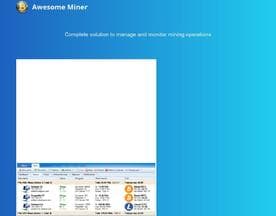
Cryptocurrency mining management is a distinct segment. Buyers here are typically smaller teams or individual operators managing mining rigs, monitoring hash rates, controlling power costs, and optimizing pool selection. Tools like AIOMiner and Awesome Miner operate in this space, built specifically for managing mining hardware and software configurations at scale, without the geological or logistics functions that industrial operations require.
Conflating the two leads to wasted evaluation time. Know your segment before you open a browser tab.
What to Evaluate in Industrial Mining Software
For industrial operations, the evaluation criteria go deeper than feature lists.
Integration with site systems
Mining operations run on a web of existing systems: SCADA platforms, ERP systems, laboratory information systems, and others. Software that can't communicate reliably with these is software that creates extra work rather than reducing it. Ask vendors directly which systems they've integrated with in the field, not just in theory.
Deployment model and connectivity
Underground and remote mining environments often have unreliable connectivity. Cloud-first tools built for stable internet connections can fail in exactly the conditions you need them most. Ask whether the software functions offline, how it syncs when connectivity is restored, and whether data integrity is maintained during network outages. This is a deal-breaker question, not a nice-to-have.
Regulatory and compliance support
Mining is heavily regulated, and compliance requirements vary by jurisdiction. A platform that handles reporting well in one country may not map cleanly to requirements in another. Vendors like Centric Mining Systems focus specifically on operational mining environments and the compliance structures that come with them. Evaluate how the software handles audit trails, incident reporting, and jurisdiction-specific reporting formats.
Configurability versus out-of-the-box fit
Highly configurable software sounds appealing until you're six months into an implementation and still building the workflows you assumed would come ready-made. Ask for a clear picture of what ships standard and what requires configuration or professional services. If configuration is required, get a realistic time and cost estimate, in writing.
What to Evaluate in Crypto Mining Management Software
The priorities shift considerably here. You're dealing with fast-moving hardware environments, volatile economics, and a much tighter feedback loop between software decisions and outcomes.
Device and algorithm support
The hardware landscape changes quickly. Software that doesn't keep pace with new ASIC models or GPU architectures will limit your options as you scale or upgrade. Check update frequency and how actively the vendor tracks new hardware releases.
Monitoring depth and alerting
Real-time visibility into hash rate, temperature, power draw, and error states is the baseline. What separates stronger tools is the quality of alerting, specifically, how quickly and reliably they surface problems before they become costly downtime. Bitvest Mining is one platform in this space worth examining for its monitoring and remote management capabilities.
Pool and profitability management
Switching pools and algorithms in response to market conditions is a real operational need for active miners. Evaluate whether the software supports automated switching and how it calculates and presents profitability data. Manual-only approaches don't scale.
Questions Worth Asking Before You Sign Anything
Regardless of which segment you're buying for, these questions tend to surface the issues that demos don't:
- Who owns the data, and what happens to it if you cancel?
- What does the implementation timeline look like for an operation your size?
- How are updates handled, and do they require downtime?
- What does support actually look like at 2am when something breaks on site?
- Is the pricing model stable, or are there usage-based components that could escalate?
Vendors who give vague answers to these questions aren't hiding complexity by accident. Push for specifics, and treat hesitation as a signal.






The Evaluation Mistake Worth Avoiding
The most common mistake we see in mining software procurement is buying for the operation you have today rather than the one you expect to have in two to three years. Expansion plans, new site acquisitions, regulatory changes, and fleet growth all affect what a platform needs to handle. Software that fits perfectly now but can't scale or adapt becomes a replacement project sooner than you'd like.
Buy for where you're heading, not just where you are. That means asking vendors about their roadmap, their customer base, and how they've handled growth scenarios for comparable operations. The answers won't be perfect, but the conversation will tell you a lot about how the vendor thinks.
Getting mining software procurement right isn't about finding the most feature-rich platform. It's about finding the platform whose strengths align with your specific operational pressures, and whose weaknesses fall outside the areas that matter most to you. That match is harder to find than a features checklist suggests, but it's the only match worth making.
