


Text messages get read. That fact alone has sent a lot of businesses rushing into SMS campaigns without thinking carefully about what they actually need from the software behind those messages. The result is a crowded inbox on both sides: customers getting blasted with generic offers, and operators paying for a platform that does far more (or far less) than the job requires. If you are building a shortlist for SMS marketing software, the goal is not to find the most feature-rich option or the cheapest one. It is to find the right fit for how your business actually communicates.
The Real Job SMS Software Is Doing
Before you compare platforms, get clear on what you are actually asking the software to do. SMS marketing covers a surprisingly wide range of use cases, and platforms are often designed with one of them as the primary use case.
Some businesses use text messaging for broadcast campaigns: promotions, flash sales, event reminders sent to a large list all at once. Others need it for transactional messaging, the kind where a customer books an appointment and gets an automated confirmation and reminder sequence. A third group wants two-way conversation, where staff can send and receive texts with individual customers in something closer to a real dialogue.
These are not the same job, and a platform optimized for bulk broadcasting may handle two-way conversation poorly, or not at all. Text Request is built around business texting that includes two-way conversation threads, which makes it a different kind of tool than a pure campaign broadcaster. Knowing which use case dominates your workflow before you open a demo will save you a lot of time.
What the Specs Sheet Will Not Tell You
Most SMS platforms will list similar capabilities: contact list management, scheduled sends, opt-out handling, keyword triggers, and some kind of reporting dashboard. These table-stakes features do not differentiate much at the shortlist stage. What matters more is how those features behave at your scale, with your audience, in your market.
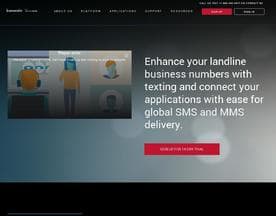
Deliverability is the most important factor most buyers underweight. An SMS that does not arrive is worse than no SMS at all, because you have paid for it and your customer may have been expecting it. Deliverability depends on carrier relationships, sending infrastructure, and how the platform handles compliance filtering. Platforms like Aerialink operate at the infrastructure layer, giving businesses access to carrier-grade routing, which matters significantly when volume is high or international delivery is part of the picture.
Compliance support is not optional. In the US, the Telephone Consumer Protection Act (TCPA) governs how businesses can contact consumers by text. That means you need clear opt-in collection, functional opt-out handling, and a platform that does not make those mechanisms easy to circumvent. Good software should make compliance the path of least resistance, not an afterthought buried in the settings.
Integration depth matters more than the number of integrations listed. A long integration list that includes your CRM in name only, with no real data sync, creates more manual work than it removes. Before committing, confirm how the platform connects to the tools your team already uses, and test whether that connection actually works in both directions.
Volume, Geography, and Pricing Structure
SMS pricing is almost always usage-based to some degree, which means your costs will scale with your contact list size and send frequency. That is straightforward enough. What trips buyers up is the gap between what they expect to send and what they actually send once the campaigns are running.
Build in headroom. If a platform's pricing becomes punishing at volumes slightly above your current activity, that is a constraint that will matter the moment a campaign performs well.
Geography deserves its own check. If any portion of your audience is outside your home country, confirm that the platform supports those routes and understand whether international rates are significantly higher. SMSCountry focuses specifically on international SMS delivery and bulk messaging infrastructure, which makes it worth considering if cross-border reach is a priority rather than a secondary concern.
For businesses with simpler, more focused needs, platforms like Mobile Text Alerts offer a more straightforward setup oriented toward list-based alerts and notifications, without the overhead of enterprise-grade infrastructure you may not need.
Features Worth Prioritizing at the Shortlist Stage
Not all features deserve equal weight. Here is what to actually interrogate during a trial or demo:
- Subscriber list management. Can you segment by behavior, preference, or custom field? Can you import and clean existing lists without hitting friction?
- Automation and triggers. Can you build sequences that fire based on customer actions, not just scheduled dates? Does the logic allow for branching based on whether a message was received, clicked, or replied to?
- Two-way messaging. If you need it, test it properly. Does the inbox interface work well enough for a staff member to manage without training?
- Analytics. Delivery rates, opt-out rates, and link click tracking at minimum. If the platform cannot show you those three clearly, you are flying blind.
- Support quality. SMS campaigns can go wrong quickly, and when they do, the speed of the support response matters. Check whether live support is available on the plan you are actually considering, not only on the enterprise tier.
Textmagic covers a broad feature set including two-way messaging, automation, and multi-user access, and is often evaluated by small to mid-sized teams looking for operational flexibility without significant setup complexity.







How to Structure Your Evaluation
Once you have a shortlist of three or four platforms, run each of them through the same scenario, your most common actual use case, not a vendor-provided demo script. Send a test campaign to a small internal list. Trigger an automation sequence. Handle a simulated opt-out. Export a report. You will learn more in forty minutes of hands-on testing than in three hours of feature comparison documents.
Ask vendors directly how they handle delivery failures, what their carrier relationships look like, and how compliance updates are communicated to customers. A vendor who cannot answer those questions clearly is telling you something.
The businesses that get the most out of SMS marketing are not necessarily using the most sophisticated platform. They are using a platform that fits their actual workflow, that their team trusts, and that makes it easy to do the right thing for subscribers. That combination is rarer than the feature lists suggest, and it is what a good shortlist process is designed to surface.


