


You already know your business is complicated. Guests book months in advance, change their minds three times, and expect a flawless experience on the day. Meanwhile, you're coordinating suppliers, managing availability across multiple products, chasing payments, and trying to answer the same questions in six different inboxes. Most software demos look great until you sit down and try to do your actual job in them. This guide is about avoiding that gap.
The Core Problem With Most Buying Decisions
Tour operators tend to buy software for the problem that is loudest right now. Maybe your booking process is a mess, so you grab the first thing with a decent booking widget. Maybe you're drowning in emails, so you look for something with built-in communication tools. That reactive approach usually leads to a patchwork of tools that don't talk to each other, with data scattered across spreadsheets and platforms that each solve one slice of the problem.
Tour operator software is a broad category. It spans everything from lightweight booking systems built for single-guide adventure companies to full-stack tour management platforms handling complex multi-day itineraries, wholesale distribution, and agent commissions. The mistake is assuming a solution designed for one end of that spectrum will stretch to fit the other.
Before you even open a demo, get clear on where your business sits. Are you selling directly to consumers, or are you also working with travel agents and wholesale partners? Do you run fixed departures, private tours, or both? How many products do you manage, and how often does availability change? These answers will narrow the field faster than any feature checklist.
What the Feature List Won't Tell You
Software vendors are good at listing features. They are less forthcoming about the operational assumptions baked into those features.
Take itinerary building. Most platforms have it. But some are designed around straightforward day-by-day linear trips, while others can handle complex nested components, optional add-ons, and dynamic pricing across different room or departure configurations. A feature called "itinerary builder" in one tool and another can describe two entirely different levels of capability. The same is true for booking management, payment handling, and supplier connectivity.
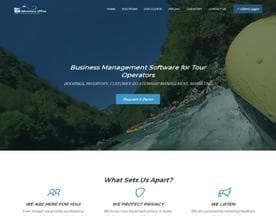
This is where the category splits in a meaningful way. Tourplan sits at the complex end, built for operators managing wholesale distribution, multi-component tours, and agent pricing structures. Something like Adventure Office is better matched to activity and adventure operators who need fast booking flows, waiver management, and guide scheduling without the overhead of a full back-office system. Neither is better in the abstract. They're built for different operations.
The diagnostic question isn't "does it have this feature?" It's "does the way it handles this feature match how my operation actually works?"
The Booking Flow Is Your Trust Signal
Your booking flow is the one part of the software that your customers experience directly. It is also, surprisingly, the area where operators make the most compromises during evaluation. They fall in love with the back-office reporting or the supplier management tools, and they accept a clunky checkout experience as the price of admission.
Don't do that. A booking flow that confuses guests creates abandoned carts, unnecessary support calls, and refund requests that never needed to happen. Run the guest experience yourself, on mobile, before you commit. Click through as if you're a first-time buyer who isn't sure what they want. Pay attention to how options are presented, how extras are surfaced, and what the confirmation looks like.
Tools like BookingTimes and ActivityChoice have leaned hard into the consumer-facing side of the experience, which reflects their target market of activity providers who live and die by conversion rates. If your revenue depends on direct online bookings from consumers who comparison-shop before they commit, the booking experience deserves at least as much scrutiny as the back-end.
Integration and Distribution
Almost no tour operator runs entirely within one platform. You're likely connected to payment processors, accounting tools, channel managers, or online travel agencies. The question isn't whether the software has an open API or a list of integrations. The question is whether the specific connections you need are solid, maintained, and won't require a developer every time something breaks.
Ask vendors directly: which integrations are native, which are built on third-party middleware, and which are documented well enough for your own team to troubleshoot? A marketplace integration that worked eighteen months ago and hasn't been touched since is not the same as one that is actively maintained.
Distribution matters here too. If you rely on agent networks or need to push availability to resellers, check whether the platform supports that model structurally, not just through manual workarounds. CSI Media has built tooling for operators who need to manage multiple channels and agent relationships without rebuilding that logic from scratch on each booking. That's a specific fit for a specific distribution model, not a universal selling point.
Scaling Without Rebuilding
The platform you choose today should still work for you when your operation grows. That means thinking about more than current feature needs. Consider how the pricing model scales as you add users, products, or transaction volume. Consider whether the vendor's roadmap is moving in a direction that aligns with where you want to take the business. Consider how much customisation you need now, because systems that require heavy setup work are harder to migrate away from later.
AnyGuide takes an approach worth examining for operators who want flexibility in how they configure and present their products, particularly if product catalogue management is a pain point. That's a different concern from an operator whose catalogue is stable but whose operational complexity is growing.
Growth doesn't break software overnight. It exposes the assumptions the software was built around. The more clearly you understand your own operational model before you buy, the less likely you are to discover those assumptions the hard way.







The Real Evaluation Shortcut
Here it is. Instead of running a full feature-by-feature comparison across six platforms, build a short scenario from your own operation. Take a real booking situation that caused you a problem in the last month. A last-minute availability change, a group booking with custom pricing, a refund that required multiple steps across systems. Walk each shortlisted vendor through that scenario during the demo. Watch how their software handles it, not how the salesperson narrates around it.
That one test will tell you more than any feature grid. Software that handles your actual edge cases with minimal friction is software worth paying for. Everything else is speculation.


