


You can spend weeks evaluating platforms, sit through a dozen demos, and still end up with software that creates more friction than it removes. The problem usually isn't the software itself. It's that most agencies start the buying process with the wrong question. They ask "what features does this have?" before they've answered "what is actually slowing us down right now?"
That gap between features and problems is where bad purchasing decisions live.
The Real Job of Agency Software
Advertising agency software covers a wide range of tools: campaign management, client reporting, media planning, creative workflow, billing, and more. The category is broad enough that two agencies buying "agency software" might end up with products that share almost nothing in common. That's not a flaw in the market. It reflects the fact that agencies themselves vary enormously in what they actually do.
A performance-focused digital shop has different operational bottlenecks than a full-service agency managing brand strategy and creative production simultaneously. Before you evaluate a single vendor, you need to be honest about where your agency's work breaks down. Is it client communication? Reporting overhead? Campaign execution across multiple channels? Resource scheduling? The answer shapes everything else.
What Separates Useful Software From Feature Lists
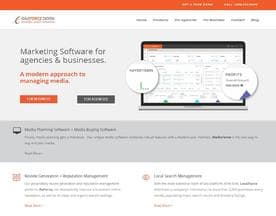
The vendors in this category range from broad platforms to highly specialized tools. Some, like Veza Digital and GaleForce Digital Technologies, approach the market with digital performance capabilities at their core. Others, like Appvertiser AI, lean into automation and machine learning as their primary value proposition. Neither direction is inherently better. The question is which direction matches the work your team does every day.
What tends to mislead buyers is the demo effect. Vendors are very good at showing you workflows that look elegant under ideal conditions. What they rarely show you is how the system behaves when a client changes the brief three days before launch, or when you're running simultaneous campaigns across five channels and one data feed breaks. Push vendors on edge cases, not just standard scenarios.
Integration Should Be the First Filter, Not the Last
Most agencies already have tools they rely on. Ad platforms, reporting dashboards, project management tools, invoicing systems. If a new piece of software doesn't connect cleanly with those existing systems, you're not buying a solution. You're buying a new island of data that someone has to manually reconcile.
Ask every vendor, early in the conversation, which integrations are native and which require a third-party connector or custom development. Native integrations are maintained by the vendor and tend to be more reliable. Third-party connectors introduce additional failure points and often add cost. Custom development means you own the maintenance burden indefinitely.
This isn't about being picky. It's about recognizing that a tool with slightly fewer features but clean integration into your existing stack will outperform a feature-rich platform that creates data silos.
The Client-Facing Layer Matters More Than Vendors Admit
Agencies often underestimate how much time they spend on client communication, reporting, and approval workflows. These aren't glamorous problems, but they are expensive ones. If your team is spending significant hours each week building reports manually, chasing approvals over email, or explaining the same campaign metrics in different formats for different clients, that's a cost that compounds across every account you manage.
Look for platforms that give clients a clear window into campaign performance without requiring your team to act as the translator every time. Tools like AskEva address this by focusing on how information flows between agencies and their clients. The underlying principle is simple: less time on internal and external reporting means more time on the work clients actually pay for.
Scaling Up Is a Different Problem Than Getting Started
Here's a mistake agencies make repeatedly. They buy software for the agency they are today and discover it doesn't support the agency they become in two or three years. Adding headcount, taking on larger clients, expanding into new service lines. All of these change your operational requirements in ways that are hard to anticipate when you're in evaluation mode.
Ask vendors specifically how their platform handles increased volume, more complex account structures, and multi-user permissions. Ask for honest context on where current customers tend to hit limits. A vendor who answers this question evasively is telling you something important.
Platforms like 9AM and ANEGIS have positioned themselves around structured workflow and operations management, which tends to matter more as team size and account complexity grow. That kind of operational backbone doesn't feel urgent when you're small, but its absence becomes very visible once you're not.
Pricing Models Deserve Scrutiny
Agency software is priced in a variety of ways: per seat, per client account, by data volume, or as a flat monthly fee. None of these structures is inherently better, but each one has a different risk profile depending on how your agency is structured.
Per-seat pricing is predictable if your team is stable, but it penalizes growth. Per-account pricing scales with your book of business, which aligns vendor incentives with yours, but it can become expensive quickly if you manage a large number of smaller clients. Data-volume pricing often looks affordable at the entry level and becomes a surprise at scale.
Map out two or three realistic growth scenarios and run each pricing model against them before you commit. The cheapest option at your current size is not always the cheapest option at twice your size.







What Good Evaluation Actually Looks Like
A good evaluation process starts with a documented list of your current operational pain points, ranked by how much time or money they cost you. Every vendor you speak to should be tested against that list, not against their marketing materials.
Run a structured pilot with real work, not synthetic test data. Assign someone on your team the explicit job of stress-testing the parts of the system you care about most. Set a clear timeline, a clear decision framework, and a clear definition of what "this is working" looks like before the pilot begins.
The agencies that end up with software they're still happy with two years later aren't necessarily the ones who spent the most time evaluating. They're the ones who knew what they were evaluating for.


